Spring hiking in Japan

Now that spring is more or less over, I thought I’d reflect back on the season since I did a lot of hikes in spring this year. Before we go any further though, lets define spring.

Generally, the sakura season coincides with the arrival of spring, so this starts in late March until the end of the rainy season, which is around the middle of July. In Japan, seasons on mountains can roughly be divided into 冬山 (fuyuyama – winter mountain) and 夏山 (natsuyama – summer mountain), with a transition period inbetween called the 残雪期 (zansetsuki – period with remaining snow). Spring for mountains around Tokyo with elevation lower than 2000m generally do not have the transition period because they hardly accumulate any snow.

How do we know which season a mountain is in? Well, one can look at the snow (or lack of) on the ground. However, since many mountains often have a history where they were once worshiped for religious reasons, there is often a day of ceremony that marks the transition from a winter mountain to a summer mountain. This day, 山開き (yamabiraki), literally meaning “opening of the mountain”, signals the start of the hiking season for summer. Conversely, 山じまい(yamajimai) is closing of the mountain, usually late in autumn when the winter closing n.

For most the mountains with an elevation of 2000m or above the Japanese alps and those north of Kanto, spring is still very much snow season. The difference with winter is that there isn’t any new snowfall, and the day is much warmer.

Whether and when mountain is climbable in spring depends largely on one thing – when snow removal starts. For routes that start nearly well populated or popular areas or, snow removal happens all year around. An example would be Mt Iizuna (飯縄山), which lies on the route to Togakushi Shrine, a popular tourist attraction. On the other hand, some roads like those on the far side of Oze only gets cleared of snow in late June. The majority are cleared at the end of April just in time for the golden week holidays. Checking for road closure information right before you leave is crucial as there are often last minute changes.

Spring can also be technically difficult and exhausting. With the receding snow comes new challenges. In winter, you can often put on crampons right from the start since the entire course is covered in snow. In spring, there are often large patches without snow in between. These areas could either be rock, or vegetation poking out. This can lead to a lot of time taking off and on crampons and awkwardly climbing over vegetation. The melting snow also often cause the path to be waterlogged and muddy. It’s important to plan and give yourself more time in spring.

That being said, spring can be a fun time to get a headstart on popular mountains before the summer crowd arrives.

Mt Shirouma (白馬岳)

Mt Shirouma (or Mt Hakuba, there are two readings of the same kanji) is located in the Hakuba area, which is well known for the ski resorts. It is also the location of one the longest snow valley in Japan. Simply known as 大雪渓(the great snow valley), this offers a shortcut up to Mt Hakuba during winter and spring. Calling it a shortcut is a bit of a misnomer. It is still a long 10~12 hours hike. However, it reduces what is usually a 2-day trip to a single day trip.

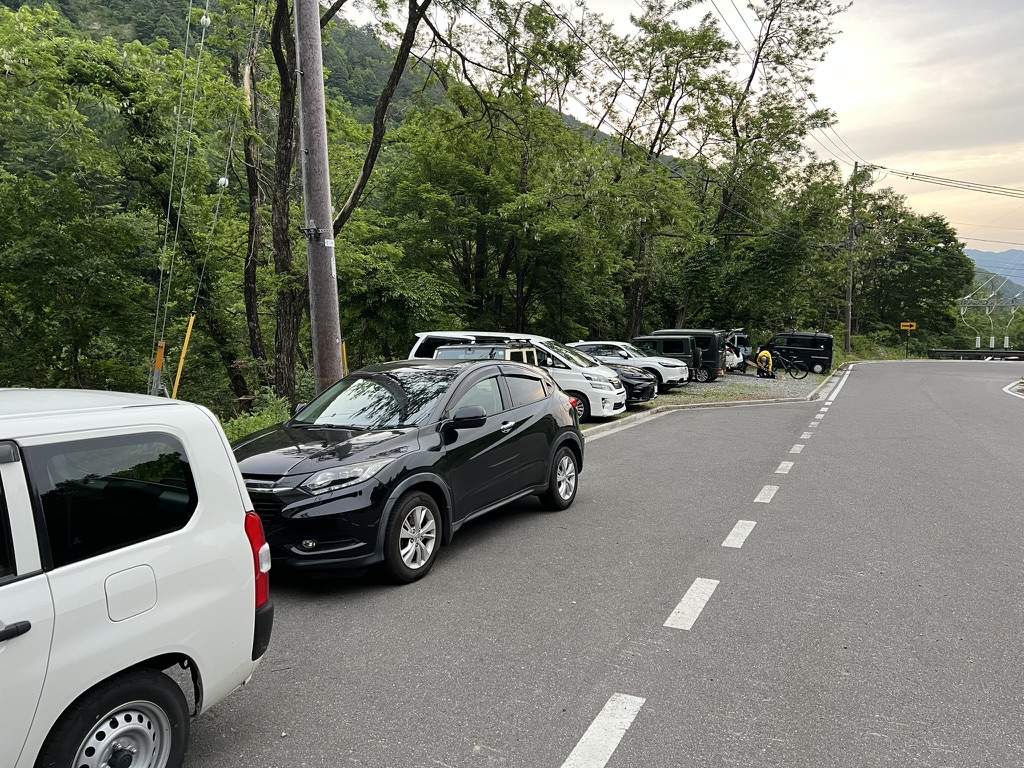
The long hike was make longer this year due to the road between the Futamata gate (二股ゲート) and Sarukura (猿倉). Originally planned to be open ahead of golden week, it remained closed. Vehicles had to park an hour’s walk away from the trailhead.

There was about 15 spots available at the car park depending how cars are parked. It was mostly fully by the time I arrived and I took one of the last 2 spots. Some people were putting together their bicycles to ride up the closed road ahead to Sarukura.

Along the way to Sarukura, I spotted a helicopter loading up supplies to be carried to the mountain hut. It would make a number of trips back and forth that morning.

The path from Sarukura was rough and overgrown. Many trees were once covered by the snow but now they where breaking through and stuck out in weird angles. There was a particularly iffy spot where it seemed like I had to cross a swelling river, but the snow bridges around it were either gone or thinned out so much that it didn’t look safe.

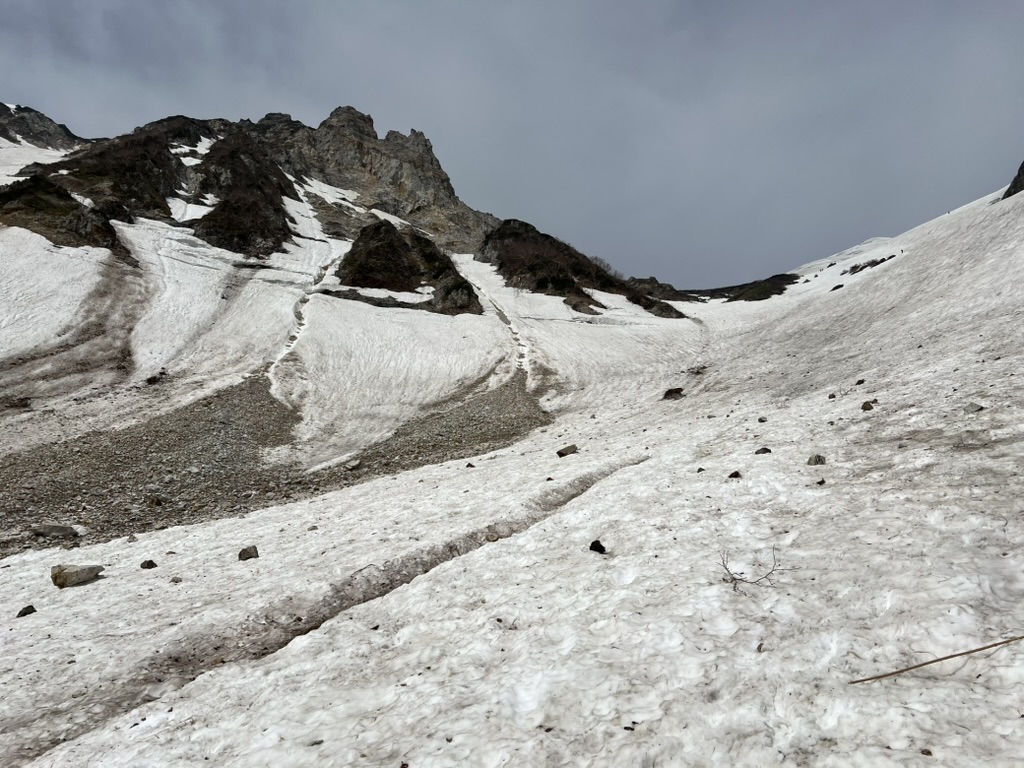
After beating through all the vegetation and not falling into any rivers, the view opens up to a large expanse of snow flanked by various peaks on both sides. There it was, the great snow valley.

Being late in season, the snow here is crunchy and strewn full of debris carried down by melting snow. Throughout the later half of the day, I could hear the sound of mini avalanches as the melting ice cause pieces of rock to break off from the cliffs around the side the valley.

As the gradient of the slope got steeper, I swapped out my trekking poles for an ice axe. It was pretty tiring going straight so I started to zigzag my way up. Even so, I got tired enough and at some point I was stopping after every few steps.

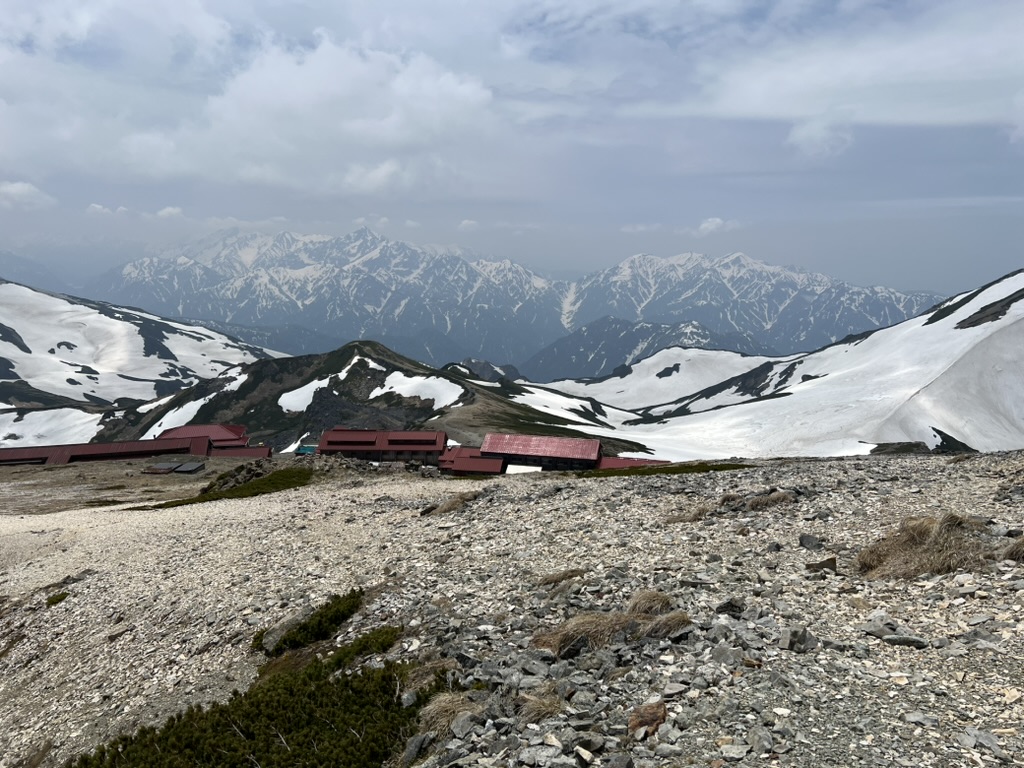
At long last, I reached the Hakuba Hut (白馬山荘), which is just minutes from the peak. Here, the snow vanished. I confirmed with the staff at the hut that there was no snow further ahead. Then, I took off my crampons and left my backpack behind in the hut for a short walk to the peak.

Returning from the peak back down to the hut, I was greeted with the majestic sight of Mt Tsurugi and Mt Tateyama, two other of the hundred famous mountains. I took in the view as I ate my lunch, and feeling my energy coming back, headed back down.

Getting there

Date hiked: 2025/06/08

Stayed the night before at Kurobe Sun Valley Hotel. It’s a really nice place and I was sad that I didn’t get to enjoy it much since I arrived late and had to leave before the break of dawn. From the hotel, it was a 40 minutes drive to the trailhead.

For the trailhead and car park, I set the navigation to 中部電力二股水力発電所.

YAMAP track: https://yamap.com/activities/40641207

Mt Sukai (皇海山)

I had imagined that Mt Sukai would be just be a heavily forested hiked and I’d be beating my way through the bushes. I was mostly right but there were some small scrambles to balance it out.

I started the hike early in the morning at 5:30am after driving there for a bit over an hour from my hotel. From the car park, it’s about an hour’s walk up a closed but mostly paved road to the start of the trail head.

There’s quite a bit of these kinds of road, where at some point whoever was maintaining the road decided it was not worth it anymore and it just gets closed. Looking at the tracks on the ground, it seemed like someone might have rode a bike to close the distance.

The trail head

Two hours in, I reached the Koshin mountain hut (庚申山荘). Like the road I passed, it has now fallen out of disrepair and no longer operated. It looked a little spooky, even under the bright morning sun. When I passed by again later on the way down with an overcast sky, it gave off creepy vibes. The toilet nearby is still open though. Here, I took a short break to fuel up.

Spooky hut in the woods
Koshin Mountain Hut

The route that I took today is apparently what is known as a “classic route”, which means that it was once used by the people of yore. It also usually means a longer and more difficult route compared to the newer routes that have been opened up since that. However, in this case, this route to Mt Sukai, crossing over a few other peaks with numerous ups and downs, is the only route available today. A shorter, 5 hour approach was closed in 2020 from what I read.

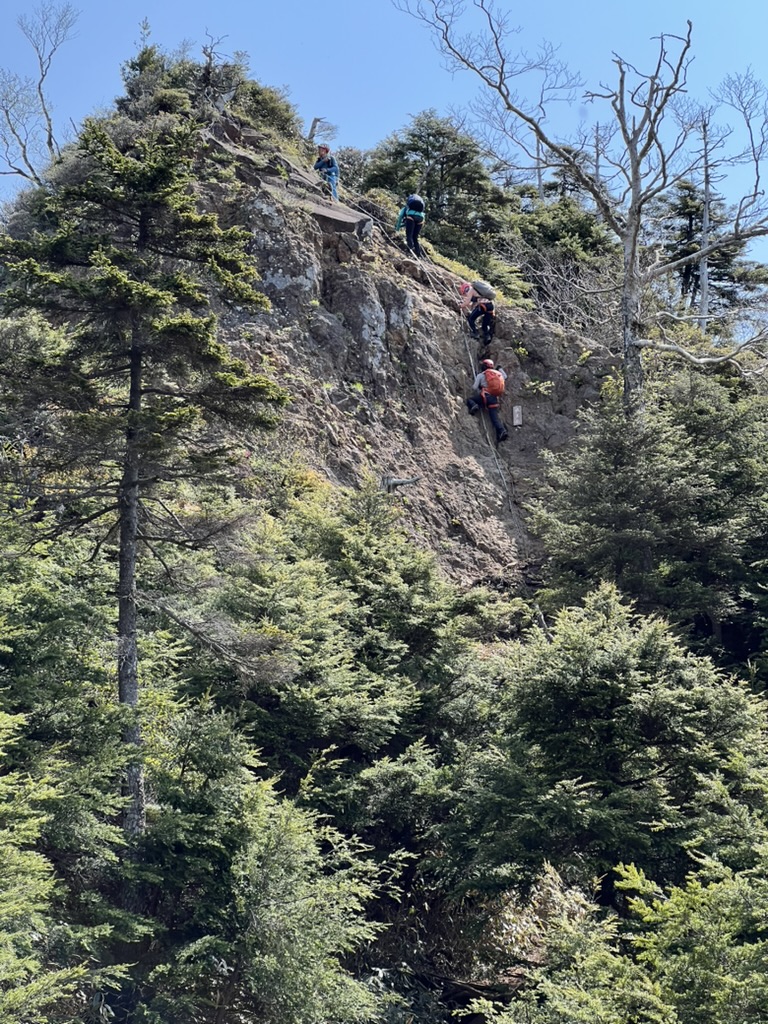
The path up until had a very gradual incline. But from the hut onwards, the path started getting rough. Between Yakushidake (薬師岳) and Nokogiriyama (鋸山), there are number of scrambles. For me, this was the best part of the hike. It had been almost half a year ago since I last did any scrambling and I was happy to get back into it. I feel so much more involved being able to use my entire body instead of just my legs. It brought to mind how long winter had been.

A group going down the rock face

Once Nokogiriyama has been passed, the trail returns to mostly normal walking. There is quite a bit of descent between Nokogiriyama and the peak of Mt Sukai but I was able to push on quickly knowing that I was almost the peak.

The peak doesn’t have too much of a view. I took the obligatory picture of the sign showing the name and altitude of the peak, had a quick snack and started back down. It has been about 5 hours since I started, and there was about the same amount of time needed to go back down.

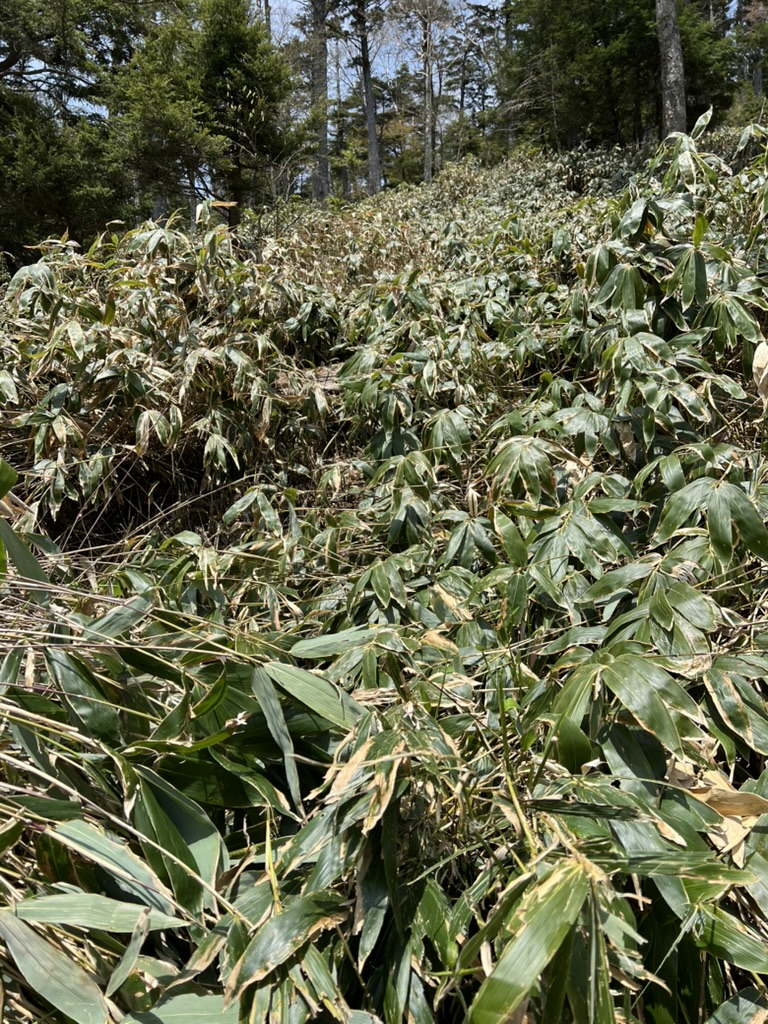
The course I took is a circular route that loops around back down, avoiding some of the peaks I had crossed. The return back wasn’t technical, but it was way more frustrating. Most of the return route is covered by overgrown sasa, a kind of low growing bamboo. In many areas it reached up past my waist. This was bushwalking in the very literal sense of the word. I lost the trail many times. Either the route seemingly disappeared or that there were multiple routes, some probably made by animals that I was confused which to take. It felt like forever.

Overgrown with sasa

Eventually I got through sasa hell and back on a much gentler path. At this point I felt pretty bored and was happy to finally reach the car park.

Getting there

Date hiked: 2025/06/02

Stayed the night before at Hotel R9 The Yard 桐生. From there it is an hour drive to Ginzandaira Parking Lot (銀山平駐車場). Dropped by Mizunuma Onsen on the way back.

YAMAP track: https://yamap.com/activities/40457938